

If you’ve ever watched a medical drama, you’ve probably seen two life-saving moments mixed up. Someone’s doing chest compressions, then suddenly, there’s a defibrillator shock and the patient magically wakes up. Real life? Not exactly. CPR and AEDs do work together, but they’re not the same thing and knowing the difference can mean the difference between saving a life and losing precious minutes.
1. CPR: The Hands-On Lifeline
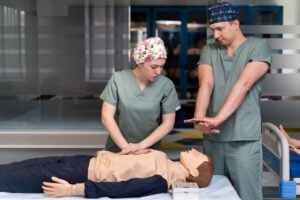
CPR, or cardiopulmonary resuscitation, is a manual way to keep oxygen flowing to the brain and organs when the heart stops beating. It’s not about restarting the heart. It’s about buying time until advanced help or an AED can step in.
When you push hard and fast in the center of the chest, you’re acting as the heart’s pump. Combine it with rescue breaths (in situations that call for it) and you’re giving the person a fighting chance.
If you’ve taken a CPR and first aid course, you know it’s physically demanding. But it’s the bridge, the thing that keeps blood moving until more definitive help arrives.
2. AED: The Heart’s Reset Button
AED stands for automated external defibrillator. Think of it as a smart device that can check a person’s heart rhythm and decide whether a shock is needed to restore it.
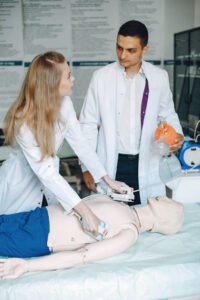
If you’re wondering “What does an AED kit do?”, here’s the simple answer: it analyzes the heart’s electrical activity. If it detects a rhythm that can be fixed with a shock, it tells you exactly when and how to do it. If not, it won’t shock at all. That means even a complete beginner can use it without fear of doing harm.
3. When to Use CPR vs. AED
- CPR: Start immediately if the person is unresponsive and not breathing normally.
- AED: Use as soon as it’s available, even if CPR has already started. The two are not mutually exclusive, you do CPR until the AED is ready, then follow its prompts and resume CPR after the shock if advised.
The American Heart Association stresses that survival rates can double or triple if defibrillation happens within the first 3-5 minutes of cardiac arrest. That’s why First aid and AED training is so valuable, you’ll know exactly what to do without losing time.
4. Why Training Matters More Than Watching Videos
You can watch a hundred YouTube tutorials, but in the chaos of a real emergency, muscle memory is everything. That’s why hands-on AED classes and CPR practice matter so much.
For healthcare professionals, CPR certification for healthcare providers goes deeper, covering advanced airway management, multi-rescuer coordination and more detailed AED usage. But even for non-medical folks, knowing the basics can turn you into the first link in someone’s survival chain.
5. The Ideal Emergency Response Flow
Here’s how it ideally plays out:
- Check responsiveness and breathing.
- Call 911 (or have someone else do it).
- Start CPR immediately.
- Send someone to grab the AED.
- Follow AED prompts.
- Continue CPR until help arrives or the person recovers.
If your workplace or community doesn’t have easy AED access, now’s the time to change that. Quick defibrillation isn’t just “nice to have”, it’s survival-critical.
FAQS:
1. What’s the difference between CPR vs. AED and do I need to learn both?
Answer: CPR vs. AED addresses two critical life-saving tools. CPR maintains blood flow through chest compressions and breaths when someone is unresponsive or not breathing. An AED is a portable device that analyzes heart rhythm and, if needed, delivers a shock to restore normal rhythm. Both are essential CPR buys time until an AED can be used.
2. When should I perform CPR vs. use an AED during a cardiac emergency?
Answer: In a sudden collapse, start CPR immediately, especially if the person is unresponsive or not breathing. As soon as an AED becomes available, attach it and follow its prompts to deliver a shock if necessary.
3. Can bystanders apply an AED even without formal CPR vs. AED training?
Answer: Yes most AEDs provide clear audio/visual instructions, making them usable by laypersons, even without formal certification. However, combining CPR vs. AED training ensures faster, more confident response in emergencies.
4. How does training in CPR vs. AED improve survival chances in an emergency?
Answer: A combination of immediate CPR and timely AED use significantly increases survival rates in cardiac arrest situations. Trained responders act faster and are better prepared to alternate compressions and AED use until professional help arrives.
The Life-Saving Combo: CPR & AED
CPR keeps the blood moving. AEDs reset the heart. Together, they give someone their best shot at survival. The magic isn’t in choosing one over the other, it’s in knowing how to use both in the right order, without hesitation.
So, don’t just read about it. Take the CPR and first aid course. Sign up for AED classes. Learn exactly what an AED kit does and practice until it feels second nature. Because when the moment comes, you won’t have time to think. You’ll have time to act. And that’s what saves lives.